
- What was the UGC CARE list?
- Is the UGC CARE list still valid in 2026?
- Why did UGC discontinue the UGC CARE list?
- What replaced the UGC CARE list?
- Old system vs new system: quick comparison
- How to check if a journal is safe in 2026
- What this means for PhD scholars and faculty
- Common myths about the UGC CARE list in 2026
- Frequently asked questions
- Conclusion
What was the UGC CARE list?
So let's clear it up in simple words.
If you are a PhD scholar, an assistant professor waiting for promotion, or a journal editor, this change affects you directly. A paper published in the wrong journal can cost you API points, delay your promotion, or even be rejected during a thesis review. On the other hand, a paper in a strong peer-reviewed journal builds your academic profile for years.
In this guide, you will learn:
- What the UGC CARE list was and how its Group I and Group II worked
- The exact dates when UGC stopped and discontinued the list
- Why UGC decided to scrap it
- The 8 official "Suggestive Parameters" that replaced it
- A simple scoring sheet to rate any journal yourself
- Red flags of predatory and cloned journals
- Common myths, plus answers to the questions researchers ask most
UGC-CARE stands for Consortium for Academic and Research Ethics. UGC set it up through a public notice on 28 November 2018. Its job was simple: help Indian researchers avoid fake and predatory journals by giving them a list of trusted ones.
How UGC-CARE worked: Group I vs Group II
The list had two parts:
| Group | What it included | Who checked it |
|---|---|---|
| Group I | Journals reviewed and added by the UGC-CARE cell | UGC-CARE cell at Savitribai Phule Pune University and partner universities |
| Group II | Journals already indexed in Scopus, Web of Science and selected MLA journals | The global databases themselves |
Group I was the list UGC built itself. Journal editors applied, and the CARE cell checked things like a valid ISSN, a real editorial board, a working website and a regular publishing schedule. Many Indian-language and regional journals entered the list this way.
Group II was simpler. If a journal was indexed in Scopus, the Web of Science citation indexes, or qualified MLA journals, it was automatically treated as part of the CARE list. If a journal was dropped from Scopus, it also dropped out of Group II.
The CARE cell also published regular alerts about cloned journals: fake websites copying the name and ISSN of a real journal. These alerts saved many scholars from losing money and papers.
For almost six years, "Is it UGC CARE listed?" was the first question every PhD scholar asked before submitting a paper. If you want to understand why that rule mattered so much for your career, read our guide on why UGC guideline compliance matters for your academic career.
Is the UGC CARE list still valid in 2026?
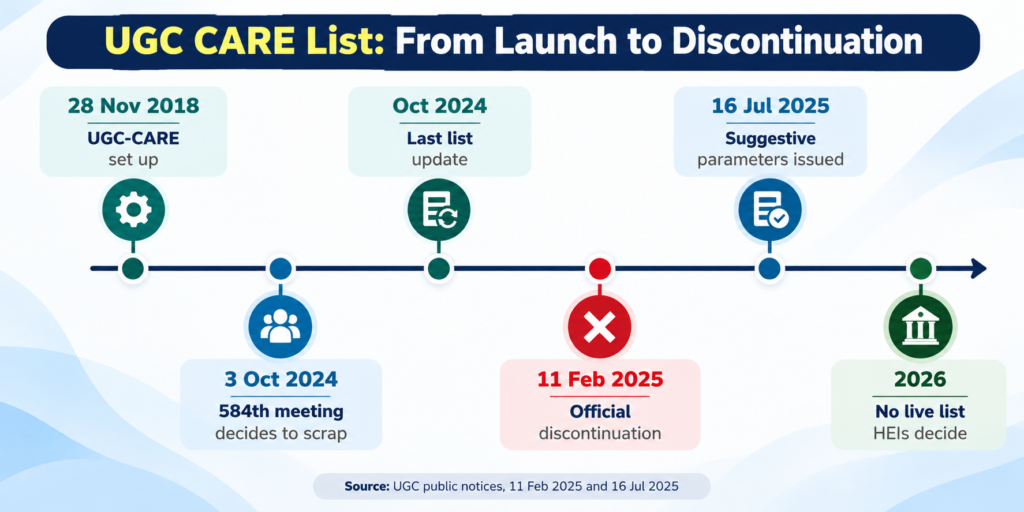
Here is how it happened, newest first:
| Date | What happened |
|---|---|
| 16 July 2025 | UGC issued "Suggestive Parameters" for choosing peer-reviewed journals and uploaded 1,474 old CARE journals for reference only (UGC notice) |
| 24 June 2025 | UGC approved the new parameters in its meeting |
| 25 February 2025 | Last date for public feedback on the draft parameters |
| 11 February 2025 | UGC public notice officially discontinued the UGC-CARE listing (UGC notice) |
| October 2024 | Last update ever made to the CARE list |
| 3 October 2024 | UGC's 584th Commission meeting decided to scrap the list |
| 28 November 2018 | UGC-CARE was set up |
Why did UGC discontinue the UGC CARE list?
UGC did not scrap the list overnight. The decision came after years of complaints from researchers, editors and universities. According to Careers360, the main concerns were centralisation, lack of transparency and subjective decisions.
Here are the problems in simple terms, and how the new system tries to fix them:
| Problem with the CARE list | What it meant for researchers | How the new system responds |
|---|---|---|
| One central body decided everything | A small cell judged journals from every subject, from physics to Sanskrit | Each university judges journals for its own disciplines |
| Sudden removal of journals | Authors found their already-published papers in "removed" journals | No list, so no sudden removal; quality is judged paper by paper |
| Cloned journals | Fake websites copied real CARE journal names and took fees | Researchers must verify ISSN, URL and indexing directly |
| Slow inclusion process | Good new journals waited a long time to get listed | New journals can be judged on merit immediately |
| Over-focus on "being listed" | Scholars chased listed journals, not quality journals | Focus moves to peer review, ethics and real impact |
What happened to journals that were on the list?
Nothing happened to them directly. A journal that was good in 2024 can still be good in 2026. However, being on the old list is no longer proof of quality. Some old CARE journals have improved, while others have slipped. That is why UGC says the reference list of 1,474 journals is only for reference, not endorsement.
What replaced the UGC CARE list?
Instead of one central list, UGC now gives "Suggestive Parameters for Peer-Reviewed Journals". Each university (HEI) uses these parameters to judge journals, and may set up its own internal committee to fine-tune them for its subjects.
The official UGC notice of 16 July 2025 groups the parameters into 8 areas:
| # | Parameter area | What to look for (in simple words) |
|---|---|---|
| 1 | Preliminary criteria | Valid ISSN, regular issues, publisher address, clear peer-review policy, secure website, archive of old issues |
| 2 | Editorial board | Real names, affiliations and subject experts on the board; clear review timelines |
| 3 | Editorial policy | Clear aims and scope, transparent APC (fees), publishing timeline, acceptance rate |
| 4 | Content quality | Papers add new knowledge and match the journal's scope |
| 5 | Journal standards | Proper referencing, professional layout, citation record, well-maintained website |
| 6 | Research ethics | Ethics guidelines, plagiarism checks, conflict-of-interest disclosure, a policy on AI-generated content |
| 7 | Visibility | Impact factor (if any) and indexing in reputed databases |
| 8 | Impact | Self-citation within normal range, total citation rate, CiteScore |
Old system vs new system: quick comparison
| Point | UGC CARE list (2018–2025) | Suggestive parameters (2025 onwards) |
|---|---|---|
| Who decides | UGC-CARE cell, centrally | Your own university or institution |
| Format | A fixed list of journals | A checklist of 8 quality areas |
| Updates | Quarterly list updates | No list to update; HEIs review parameters |
| Status in 2026 | Discontinued, reference only | Active and recommended by UGC |
| Your responsibility | Check if the journal is on the list | Check the journal against the parameters and your HEI's rules |
In short, the responsibility has moved from UGC to you and your institution.
How to check if a journal is safe in 2026
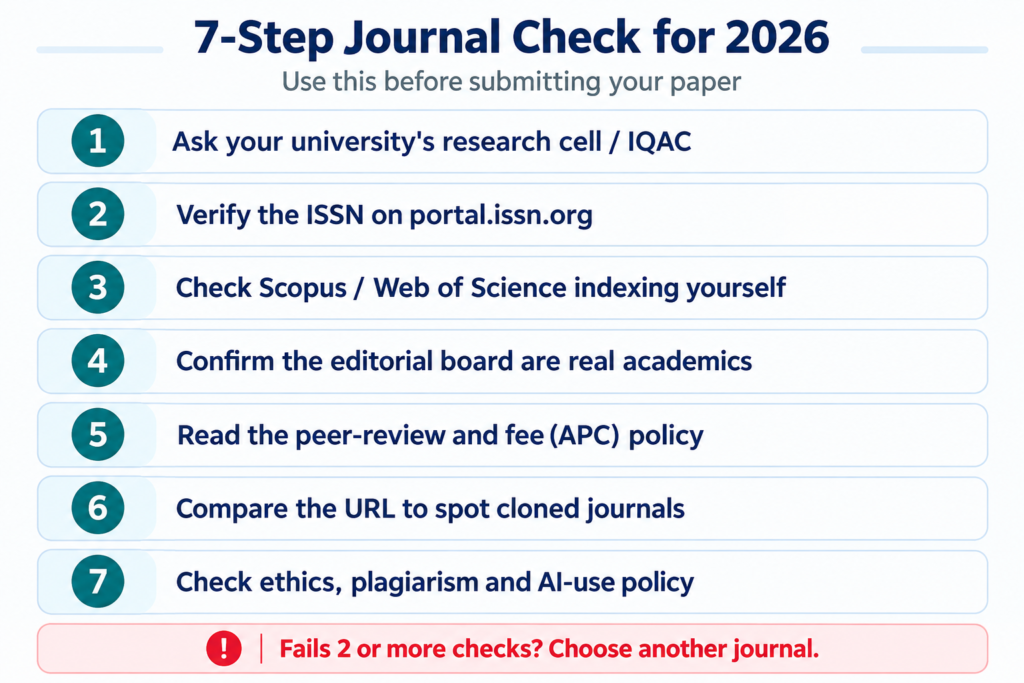
Before you submit your next paper, run this quick 7-step check:
- Ask your university first. Many HEIs now keep their own approved list or rules. Your IQAC or research cell will know.
- Verify the ISSN on the ISSN Portal. A fake or mismatched ISSN is a deal-breaker.
- Check indexing yourself. Search the journal in the Scopus source list or the Web of Science Master Journal List. Do not trust a logo on the journal's website.
- Look at the editorial board. Members should be real academics you can find on university pages or Google Scholar.
- Read the peer-review and fee policy. If a journal promises acceptance in 48 hours or hides its APC, walk away.
- Watch out for cloned journals. Compare the website URL with the original journal. The old UGC-CARE cloned journals list is still a useful warning sheet.
- Check ethics and AI policy. Good journals follow COPE guidelines and state their plagiarism and AI rules openly.
What to do if you already published in a doubtful journal
Don't panic. Here's what to do next:
Check whether the journal met basic standards when your paper was published.
Speak to your supervisor or research cell honestly.
For future work, choose journals using the checklist above, and consider building your profile with stronger publications.
What this means for PhD scholars and faculty
For PhD scholars
Under the UGC PhD Regulations 2022, publication is no longer a compulsory condition for submitting your thesis, but most universities still encourage it. Our detailed post explains this: Is paper publication mandatory for PhD in India? UGC 2022 rules. If you do publish, choose a peer-reviewed journal that meets the 8 parameters and your university's rules. Turning thesis chapters into papers? This guide helps: How to convert your PhD thesis into research papers.
For faculty members
Promotions under CAS and API scoring now depend on how your institution applies the parameters. Keep proof for every paper: indexing screenshot, ISSN record, and the journal's review policy.
How we follow these guidelines at IJRRETAS
At IJRRETAS, we follow UGC guidelines at every stage of publishing. That includes a transparent peer-review process, plagiarism screening, clear author guidelines, an openly listed editorial board, and a stated policy on publication ethics. We believe authors should never have to guess whether a journal is genuine, so these details are available on our website for anyone to check against the 8 UGC parameters.
Common myths about the UGC CARE list in 2026
A lot of confusing information is still floating around on social media and WhatsApp groups. Let's bust the most common myths:
| Myth | Fact |
|---|---|
| "UGC releases a new CARE list every year." | No new list has been released since October 2024, and UGC has said it will not be updated further. |
| "The 2026 UGC CARE PDF on websites is official." | The only official file is UGC's reference list as on 10 February 2025. Anything labelled "2026" is unofficial. |
| "Now I can publish anywhere I like." | No. You must still choose quality peer-reviewed journals, and your institution can reject weak ones. |
| "All journals on the old list are still approved." | UGC says inclusion in the reference list does not mean validation or endorsement. |
| "Scopus indexing is no longer useful." | Indexing in reputed databases is one of UGC's own 8 parameters, so it still matters a lot. |
| "Journals can still apply for CARE listing." | The CARE website now exists for information only. There is no active listing process. |
Frequently asked questions
1. Is the UGC CARE list still valid in 2026?
No. It was discontinued on 11 February 2025. Only a reference copy of 1,474 journals exists, and UGC says it is not an endorsement.
2. Can I download the UGC CARE list 2026 PDF?
There is no official 2026 list. Any "2026 PDF" online is a re-shared old list or a private compilation. The only official file is UGC's reference list as on 10 February 2025.
3. Are Scopus and Web of Science journals still accepted?
Yes, in most institutions. Indexing in reputed databases is one of UGC's own parameters. Still, check that the journal is currently indexed, not discontinued.
4. If a journal says "UGC CARE approved", is it safe?
Not necessarily. Since the list no longer exists, this claim in 2026 is often a marketing trick used by predatory journals.
5. Who decides if my publication counts?
Your university or institution, using UGC's suggestive parameters and its internal committee.
6. When did UGC stop updating the CARE list?
The list was last updated in October 2024. The official discontinuation notice followed on 11 February 2025.
7. Will UGC bring back the CARE list in future?
UGC has given no sign of this. Its July 2025 notice set the suggestive parameters as the way forward, so plan your publications around them.
8. Does a journal need an AI policy now?
UGC's parameters include an "AI Generated Content Policy" under research ethics. A good journal in 2026 should clearly explain how authors may use AI tools.
9. Is publishing in a journal mandatory for PhD submission?
Under the UGC PhD Regulations 2022, it is not compulsory, but many universities still recommend it. Read our full explainer on PhD publication rules.
10. How can I verify a journal's Scopus indexing?
Search the journal title or ISSN in the official Scopus source list. Also check that its coverage is still active and not marked as discontinued.
Conclusion
The UGC CARE list is history. In 2026, there is no official list to tick off. Instead, you judge a journal by its quality, ethics and transparency, using UGC's 8 parameters and your university's rules. It takes a few extra minutes, but it protects years of research.
Looking for a peer-reviewed journal that follows UGC guidelines? Explore the current issue of IJRRETAS, browse our past issues, or contact our editorial team. You can learn more about our publication process at ijrretas.com. For more guides, visit the IJRRETAS blog.
Sources
- UGC Public Notice, 11 February 2025 – discontinuation of UGC-CARE
- UGC Public Notice, 16 July 2025 – Suggestive Parameters (Annexure-I)
- UGC reference list of 1,474 CARE journals (as on 10 February 2025)
- UGC-CARE official website (status notice)
- Careers360 – UGC suggests parameters after scrapping UGC-CARE list
- HNLU notice regarding UGC-CARE journals
- FLAME University – UGC guidelines for peer-reviewed publications
- COPE – Committee on Publication Ethics